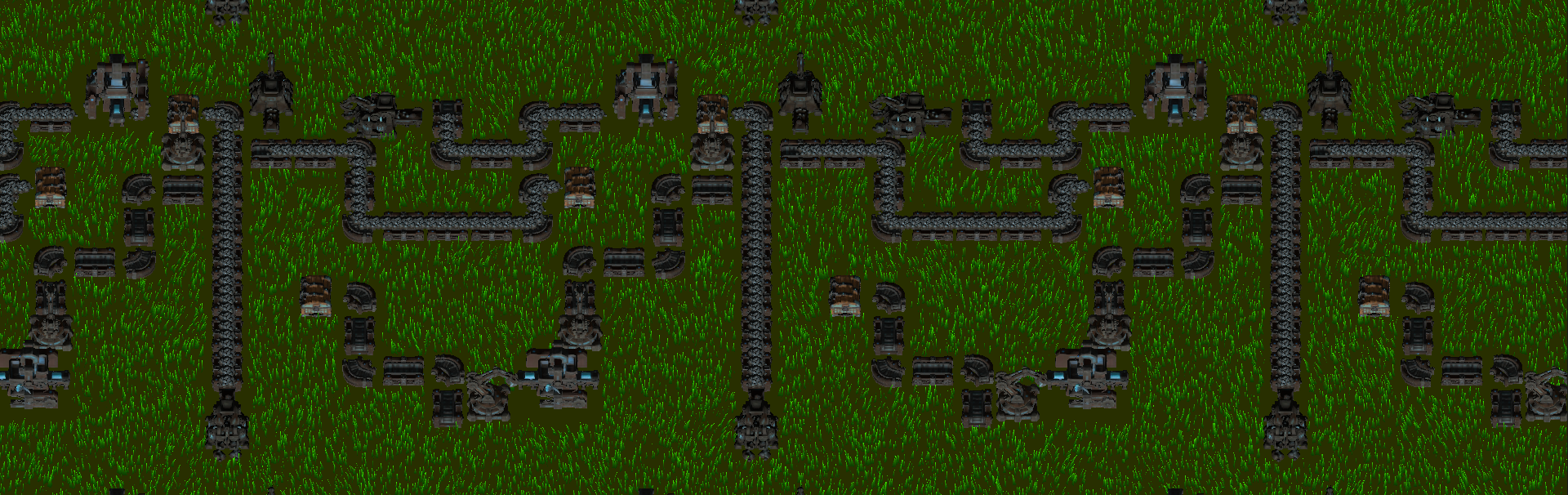
Cover

Nordustry is a real-time factory simulation game I’m building in Godot. The core idea is to build massive factories across the procedurally generated 9 Worlds of the nordic mythological worlds.

Building a factory game that can scale infinitely is a huge technical challenge. If you try to use standard game engine objects for every single conveyor belt and item, the framerate will eventually tank.

To solve this, I had to completely rethink how the game handles data. Coming from a Bevy ECS project (2026-04-19 Using ECS for Swarm Simulation), I understood that the key is not ECS (Entity-Component-System), but DOD (Data-Oriented Design). After all this is what my big inspiration Factorio uses. Wube, the developers of Factorio even mention this in a blog post I found . One of the staff, Twinsen, wrote:

I know a bit about ECS and I can say Factorio is not doing it.
We didn’t really follow any frameworks/paradigms except OOP and some C++ practices.
Afaik DOTS is quite new. I never heard of Bevy. ECS is very popular but afaik it became popular within the last 5-8 years. Factorio started development 11 years ago.

We get high performance because:

  1. We always focus on it. For almost every implementation detail we ask “what about performance?“.
  2. We code at a fairly low level, in C++. High level frameworks can easily make you forget about the basics like cache locality, context switching, branch prediction, avoiding unnecessary copying of data.
  3. We try to use the correct data structures for performance.
  4. We break OOP or clean code practices for the sake of performance, if necessary. The most common trade-off I see when writing code is do we want it simple, understandable, clean and respecting OOP or do we want it performant?
  5. We profile a lot. Even with all of the above in mind, sometimes CPUs, RAM and compilers are magic and you just profile and see if your theory holds in practice.

And of course all these add development time. Factorio is a very well optimized game, but remember that we are making it for 11 years now.

Thats why my biggest architectural rule in Nordustry is strict DOD. I completely bypass Godot’s SceneTree for runtime simulation. Instead of having thousands of Node3D objects for buildings and items, the entire factory state is managed by centralized C# managers using arrays of pure C# structs.

O(1) Logistics

Conveyor belts and items are the core of Nordustry. The main implementation is again highly inspired by one of Wube’s excellent blog posts on belt optimization.

When it comes to interacting with the items no belts with the Inserters, To keep the simulation budget under my target, I had to avoid looping over transport lines to find the correct item for each Inserter grab.

Instead, the spatial grid acts as a routing table. I use a deterministic topology where belt positions are sorted before tracing paths. When an Inserter needs to grab an item from a belt, it doesn’t search for items; it performs an lookup in the LogisticsManager to extract items directly from the tile.

// Example of how the SimulationManager handles instant lookups
public bool TryExtractItem(GridPosition pos, out uint itemId)
{
    uint tileData = World.Map.GetTile(pos);
    SpatialMap.UnpackTile(tileData, out var type, out _);
 
    if (GetProcessor(type) is IItemProvider provider)
    {
        return provider.TryExtractItem(pos, out itemId);
    }
    itemId = 0;
    return false;
}

Decoupled Rendering

Since the simulation runs purely on C# data structures, it’s completely decoupled from the rendering loop. The C# logic managers are responsible for pushing spatial and transform data directly to Godot’s RenderingServer or updating MultiMeshInstance3D buffers.

Even if the simulation logic ticks at 10Hz to save CPU cycles, the RenderManager uses a TickFraction to visually interpolate the motion. This guarantees that items and Inserter swings always look like they are running at a smooth 60+ FPS.

Inserter Interpolation GIF Placeholder: Inserters smoothly transferring items between belts and assemblers

Due to this decoupling of the simulation and the rendering components, we also set the perfect foundation for a possible multiplayer mode in the future. But that’s something I will tackle in the future If the project is worth it.

Next up, I will introduce some procedural generation to make the game world actually have content.